


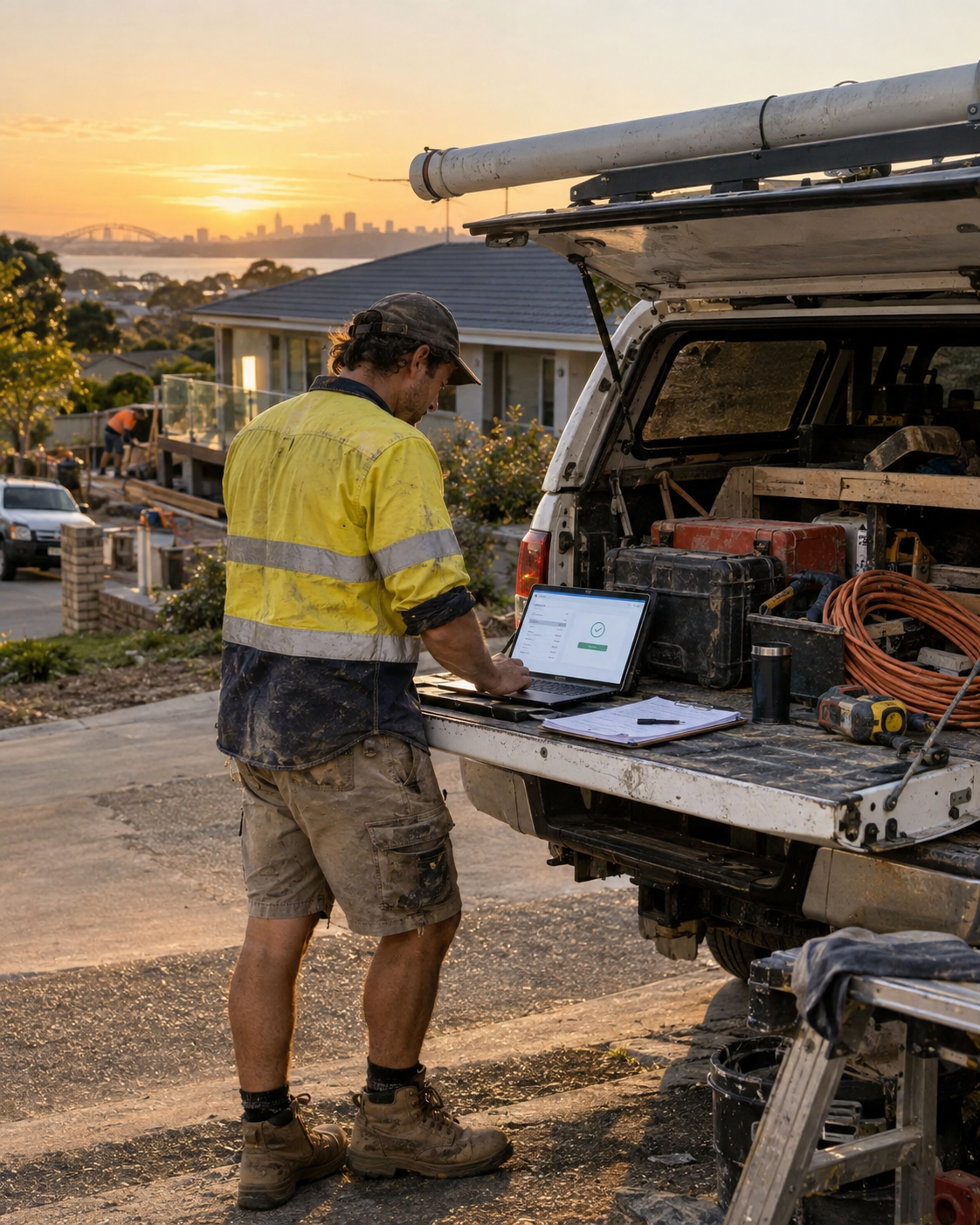
Same-Day Invoicing Stops the Free Loan to Your Client because the payment clock cannot start while the invoice is still sitting on your to-do list.
You have finished the job.
The boys have been paid. The materials have been used. Fuel has gone through the ute. Your supplier might already be expecting payment.
But your client has not even received the bill yet.
Every day you wait to invoice is effectively another day you are financing the job for them. 💸
The Payment Clock Hasn’t Started Yet
Say you finish a job on Monday.
The invoice does not go out until Friday because you tell yourself you’ll do all the invoicing together at the end of the week.
If your terms are 14 days from the invoice date, you have already added four days before those 14 days even begin.
Your client has not technically paid late.
You simply started the clock late.
Do that across several jobs every week and quite a bit of money can end up sitting outside your bank account for longer than it needs to.
That is why the Australian Government’s cash flow guidance recommends businesses send an invoice as soon as they make a sale and follow up quickly on unpaid accounts.
You’re Already Carrying the Cost of the Job
This matters more for tradies because plenty of the cash goes out before the customer’s money comes in.
Materials may need to be ordered before the job starts.
Wages still hit on payday.
Subbies expect paying.
Fuel cards, vehicle repayments, insurance and supplier accounts keep moving whether your customer has paid or not.
So when an invoice waits another three, four or seven days to go out, you are carrying those costs for longer.
It is one of the reasons a trade business can be flat out and still wonder where the cash is.
What Same-Day Invoicing Actually Changes
Same-day invoicing does not magically make every customer pay immediately.
That is not the point.
It removes the delay that you control.
Imagine two identical jobs finished on Monday.
One invoice goes out before knock-off.
The other sits there until Friday night.
Even if both customers take exactly 14 days to pay from the date of invoice, the first job has a four-day head start.
Nothing changed about your pricing.
Nothing changed about the customer.
Nothing changed about your payment terms.
You simply stopped giving away four extra days.
Multiply that across a busy month and the difference starts to matter.
Don’t Give 29-Day Terms a Head Start
This becomes even more important when you work for larger businesses.
The Payment Times Reporting Regulator’s August 2026 data shows that the average common payment term reported by larger entities has remained at 29 days.
If your customer’s payment terms already mean waiting several weeks, there is little sense adding another week because the invoice did not leave your inbox.
Clear payment terms matter too.
Business.gov.au recommends putting payment timing and payment methods on your invoices and contracts so customers know exactly what is expected.
Your client’s payment process may be outside your control.
When you send the invoice is not.
Same-Day Doesn’t Mean More Work at Night
This is where plenty of tradies push back.
“Sounds good, but I’m not sitting in Xero after every job.”
Fair enough.
Same-day invoicing should not mean swapping the tools for a laptop every afternoon.
The better system is to make the information flow happen while the job is still fresh.
For example:
- capture the customer’s correct billing details before starting
- record variations and extra materials as they happen
- make sure the boys log anything the office needs before leaving site
- mark the job complete as soon as it is actually finished
- send or prepare the invoice while everyone still remembers what happened
- have a clear process for checking overdue invoices
The less somebody has to reconstruct later, the quicker the invoice can leave.
That is also why we discuss on about proactive bookkeeping for tradies.
The goal is not more admin.
It is doing small things at the right time so they do not become bigger jobs later.
Friday-Night Invoicing Has Another Problem
There is another reason not to wait until Friday.
Details disappear.
That extra fitting you supplied on Tuesday.
The additional two hours the customer approved.
The material run nobody wrote down.
The half-day variation you discussed standing beside the ute.
On the day, everybody remembers it.
Five days later, you are scrolling through messages and asking the boys what actually happened.
That slows invoicing down again.
Worse, something can get missed altogether.
Then you are not simply waiting longer for your money.
You may never invoice part of the job in the first place.
Make the Invoice Easy to Pay
Getting the invoice out quickly is step one.
Make sure the customer can understand and pay it without another round of emails.
Your invoice should clearly show what the customer is paying for, when payment is due and how they can pay.
If you are GST registered, there are also specific requirements for tax invoices. The ATO explains what information needs to appear on invoices depending on your GST registration and the type of sale.
A fast invoice that creates three questions is not particularly fast.
Clear beats clever.
Check Your Own Invoice Gap
Here is the useful number to look at this week.
Not your total debtors.
Not your sales for the month.
Look at your last ten completed jobs and compare the job completion date with the invoice date.
How many days are sitting between them?
If it is regularly three, five or seven days, that is cash flow time you can improve without finding another customer, increasing prices or working another Saturday.
You have already earned the money.
You just have not asked for it yet. 🔧
Stop Funding the Gap
You cannot control exactly when every client pays.
You can control when you start asking.
That is why same-day invoicing is such a simple cash flow habit.
Finish the job.
Capture the extras.
Send the invoice.
Then let the customer’s payment terms start ticking.
Because Sundays are not for trying to remember what happened on a job last Tuesday – and your clients do not need another free loan from you.
Have a look at your last ten jobs today. How much time are you giving away before the payment clock even starts?