


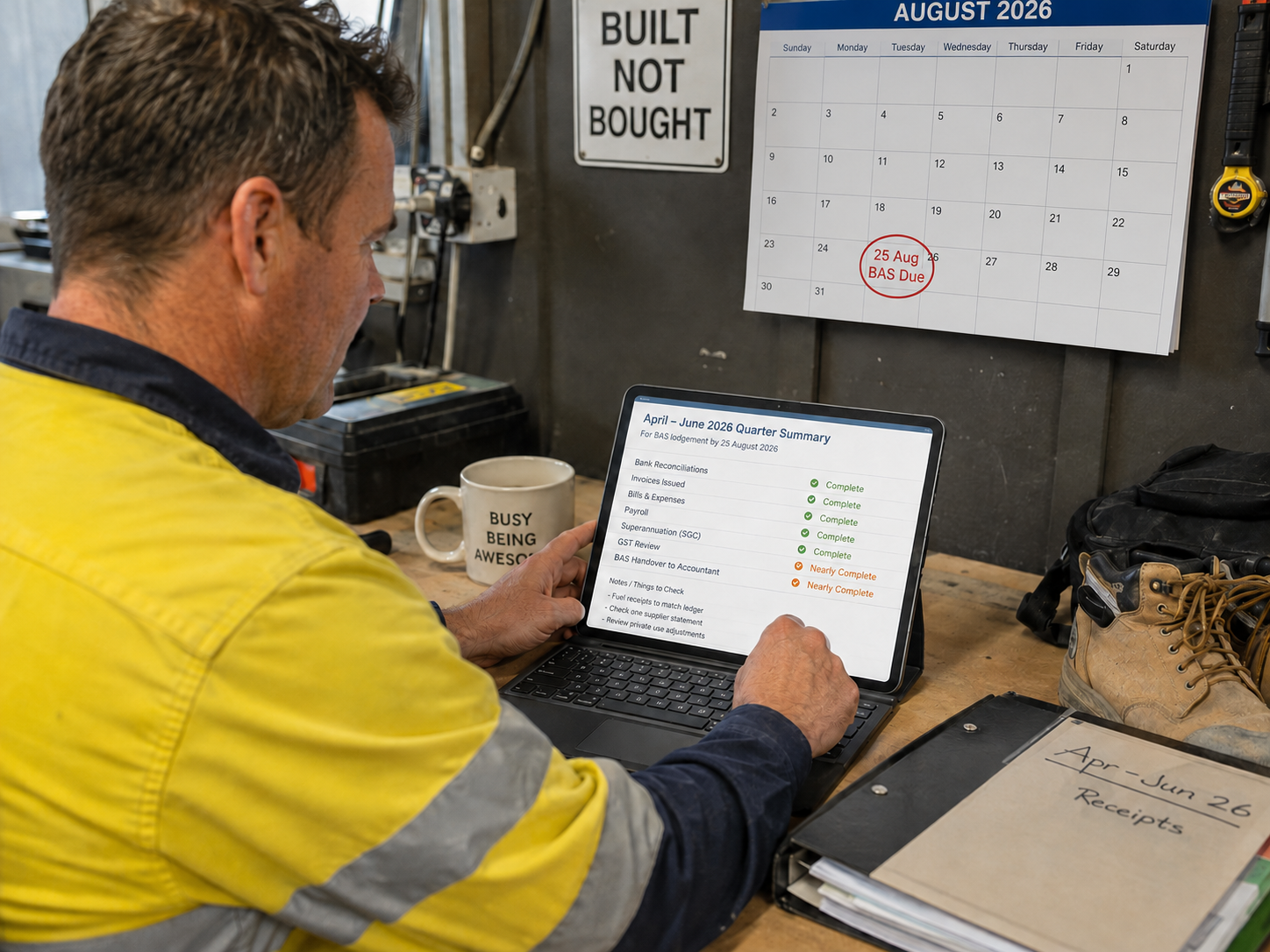
7 Critical Q4 BAS Mistakes You Need to Avoid covers the checks worth making before you hand your books to your accountant or BAS Agent. If you do your own bookkeeping and your registered agent lodges electronically, your April-June BAS may fall due on 25th August 2026.
That deadline does not mean you should finish your bookkeeping on the 24th. 😬
Your agent needs time to review the file, raise questions and prepare the BAS. They may also set an earlier cut-off date, so ask when they need your books ready.
This BAS covers the final quarter of the 2025-26 financial year, from 1st April to 30th June 2026.
Before you say, “The file’s ready”, work through these seven checks.
1. Reconcile Every Bank Account to 30th June
Start with every bank account your business uses.
Check your main trading account, savings accounts and business credit cards. Clear any transactions still sitting in the bank feed.
Next, compare the balances in your accounting software with your actual bank and credit card balances.
If something does not match, find the difference before you send the file to your accountant.
Your accountant should be able to start reviewing the BAS without first cleaning up unfinished bank reconciliations.
2. Make Sure You Recorded Every Sale
Check your customer invoices and payments for the quarter.
Look for:
- draft invoices you forgot to approve
- customer payments you have not matched
- deposits sitting without an allocation
- duplicate invoices
- transfers between your own accounts recorded as income
Your GST method affects when you report sales.
If you use the cash method, you generally report GST when you receive payment.
If you use the non-cash method, you generally report GST when you issue the invoice or receive a payment, whichever happens first.
Not sure which method you use? Ask your accountant or BAS Agent before changing anything.
3. Enter Your Bills and Find Missing Tax Invoices
Now check your supplier bills and business purchases for the quarter.
A bank transaction on its own does not always give you enough information to claim GST.
For purchases over $82.50 including GST, you generally need a valid tax invoice to claim the GST credit.
Check the supplier’s details, ABN, invoice date, description and GST amount.
If you use the cash method, you generally claim the GST credit when you pay for the purchase.
Under the non-cash method, the timing can depend on when you receive the invoice or make a payment. You also need the required tax invoice before claiming the credit.
The ATO’s guide to accounting for GST explains the difference between the two methods.
Missing an invoice? Chase it now rather than leaving the question for BAS day.
4. Review Your Coding and GST
A reconciled transaction can still have the wrong account or GST code.
Review the transactions you entered during the quarter. Pay closer attention to:
- large purchases
- unusual expenses
- transactions with no supporting documents
- items you were unsure about
- transfers between your own bank accounts
- transactions created by automatic bank rules
Bank rules can save time, but they can also repeat a mistake every week if nobody checks them.
If you are unsure about a transaction, flag it for your accountant or BAS Agent.
A clear question is much easier to deal with than a guess buried in the file.
5. Check Payroll and PAYG Withholding
If you employ staff, review each pay run for the April-June quarter.
Make sure you completed your payroll reporting correctly through Single Touch Payroll.
Then compare the PAYG withholding for the quarter with the amount showing in your BAS records.
Also compare your wage, PAYG withholding and super accounts with your payroll reports.
If the figures do not match, find out why or flag the difference for your accountant.
Do not change payroll figures just to make the accounts balance. That can create a bigger problem later.
6. Check Your April-June Super
For the final quarter under the old quarterly super system, your employees’ super funds needed to receive the April-June 2026 contributions by 28th July 2026.
Sending the payment on 28th July was not enough. The money needed to reach the employees’ funds by that date.
If the payment arrived late, speak with your accountant or BAS Agent straight away.
You may need to lodge a Superannuation Guarantee Charge statement and pay the charge by 28th August 2026.
Late super follows different rules, so do not simply treat it like a normal super payment and move on.
The ATO explains what happens when quarterly super is late.
What About Payday Super?
Payday Super started on 1st July 2026.
For paydays from that date, employers generally need to make sure super reaches employees’ super funds within seven business days after payday.
This change does not alter your April-June BAS. However, it changes the way you need to manage super from July onwards.
You can read more in the ATO’s Payday Super guidance.
7. Get Your TPAR Details Ready
Paid subbies during the 2025-26 financial year?
Your Taxable Payments Annual Report, or TPAR, may also fall due on 28th August 2026.
TPAR sits separately from your BAS. It reports relevant payments you made to contractors from 1st July 2025 to 30th June 2026.
For each subbie, check:
- their name or business name
- ABN
- address
- total payments, including GST
- total GST included in those payments
Run a draft TPAR from your accounting software and compare it with your records.
Do not assume the report is complete just because your software produced it.
A subbie may be missing because someone set them up incorrectly or used the wrong account when entering their payments.
If your accountant or BAS Agent lodges the TPAR, give them the details before the deadline rush.
The ATO confirms that TPAR is generally due by 28th August each year.
Don’t Wait Until 25th August
The 25th August 2026 date applies to eligible quarter 4 activity statements lodged electronically through the registered agent lodgment program.
It is not the day to finish your bookkeeping.
Once you complete these checks, tell your accountant or BAS Agent that the file is ready. You can also ask how much you need to pay so you can plan your cash flow.
Can’t pay the full BAS amount by the due date?
Do not ignore the lodgment. Speak with your accountant or BAS Agent about the options available to you.
Your Important August Dates
If the registered agent lodgment program applies to your BAS, keep these dates on your radar:
- Your accountant’s cut-off date: Confirm when they need your bookkeeping completed
- 25th August: April–June BAS lodgement and payment due
- 28th August: TPAR due if you paid subbies
- 28th August: Superannuation Guarantee Charge statement due if April–June super was late
That is a lot to land in the same week.
Leaving everything until after smoko on the 24th is asking for a stressful night. 🧾
You Don’t Have to Handle Every BAS Job Yourself
Doing your own books may work when the business is small.
As the jobs, invoices, suppliers and the boys increase, BAS preparation can start eating into nights and weekends.
A bookkeeper who is also a Registered BAS Agent can take care of more than data entry.
They can help reconcile accounts, review GST coding, check payroll, chase missing information and prepare and lodge BAS statements.
Your accountant can still handle your tax returns, tax planning, business structure and broader accounting advice.
The two roles can work together.
If you would rather spend less time sorting paperwork, our bookkeeping services for tradies cover ongoing bookkeeping, payroll and BAS support.
Make the Next BAS Easier
The easiest BAS is the one you do not need to rescue at the last minute.
Reconcile your accounts during the quarter. Enter bills while you still remember what they were for. Send customer invoices promptly and check payroll after every pay run.
Keeping your books up-to-date week-to-week gives you cleaner figures and fewer questions at BAS time. ✅
It also gives your accountant or BAS Agent a much better file to work with.
Bookkeeping and BAS Support for Tradies Across Australia
Tradies Bookkeeping supports trade businesses across Sydney, Melbourne, Brisbane, Perth, Adelaide, Canberra, Hobart, Darwin and beyond.
As Registered BAS Agents, we help tradies keep their bookkeeping and payroll up-to-date. We can also prepare and lodge BAS statements and work with your accountant when they need information from the books.
If doing your own bookkeeping keeps sliding to nights and weekends, it may be time to change the setup.
Get in touch and tell us which part of the bookkeeping is taking up the most time. We can start there.